The Balkans are Europe's most underrated travel region — a patchwork of cultures, landscapes, and histories that most tourists fly straight over on their way somewhere else. From the UNESCO-listed Ottoman streets of Berat in Albania to the Byzantine churches of Ohrid in North Macedonia, the medieval walls of Dubrovnik in Croatia to the rose valleys of Bulgaria, this is a corner of Europe that rewards curiosity with extraordinary visual material and almost no crowds. The Balkans are what Western Europe looked like before mass tourism arrived.
Berat, Albania is the single most photogenic town I found in the Balkans — a UNESCO World Heritage city of a thousand windows, where Ottoman houses stack up the hillside in perfect symmetry. Shoot from the castle at golden hour and you'll have one of those images that stops people scrolling.
Kotor Bay, Montenegro offers dramatic mountain-meets-sea scenery that few people associate with the Balkans. The old town walls rising above the bay make for a classic wide-angle shot, and the kayaking perspective from water level is something else entirely.
Ohrid, North Macedonia — the old church of St John at Kaneo sitting on a promontory above the lake is one of the most-photographed spots in the region, and deservedly so. Come in the early morning mist for the best light.
Sofia and Plovdiv, Bulgaria — Plovdiv's old town is a hidden gem of colourful National Revival architecture, and Sofia's Alexander Nevsky Cathedral provides one of the most striking Orthodox subjects in Eastern Europe.
The Balkans offer some of the best value travel in Europe — your daily budget stretches significantly further than in Western Europe, and the region's improving transport infrastructure makes multi-country itineraries genuinely feasible. Budget travellers can travel well here; the challenge is navigating border crossings and varying currencies efficiently.
| 🗓️ | Recommended stay | 14 – 21 days |
| 🎒 | Budget / day | €30–50 / $33–55Guesthouse, local food, buses |
| 🥂 | Luxury / day | €100–180 / $110–200Boutique hotel, restaurants, private transfers |
| 📅 | Best months | May – September |
| 🌡️ | Climate | 18–30°C · Hot dry summers, mild springsMountains can be cool — bring a layer |
| ✈️ | Visa | Visa-free for EU / US / UK in most countries (Serbia, Albania, N. Macedonia, Bulgaria) |
| 💵 | Currency | EUR in Montenegro & Kosovo · Local currencies elsewhere · Cash essential in rural areas |
| 🚌 | Getting around | Buses between countries · Taxis and walking in cities · Trains unreliable |
| 🛡️ | Safety | Medium — generally safePickpocketing in busy tourist areas |
| 🍜 | Must-try food | Ćevapi, burek, baklava, ajvar, rakija |
| 💬 | Language | English limited outside capitals · Basic local phrases appreciated · Cyrillic script in Serbia & Bulgaria |
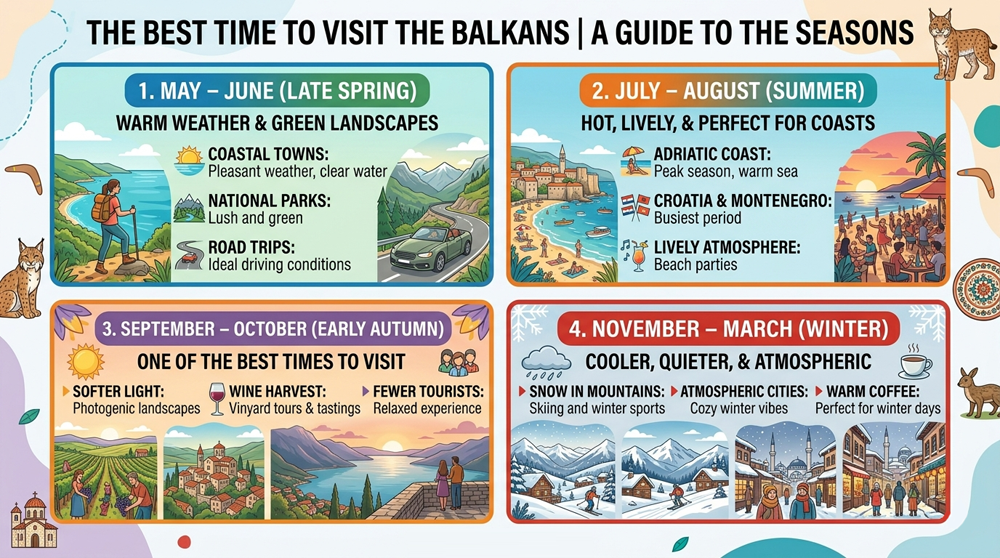
Warm weather, green landscapes, and fewer crowds before peak summer. Ideal for coastal towns, national parks, and road trips.
Hot, lively, and perfect for the Adriatic coast. Croatia, Montenegro, and Albania are busiest during this period.
One of the best times to visit — warm sea temperatures, softer light, wine harvest season, and fewer tourists.
Cooler and quieter. Mountain regions see snow, while cities like Sarajevo and Belgrade feel atmospheric in winter.
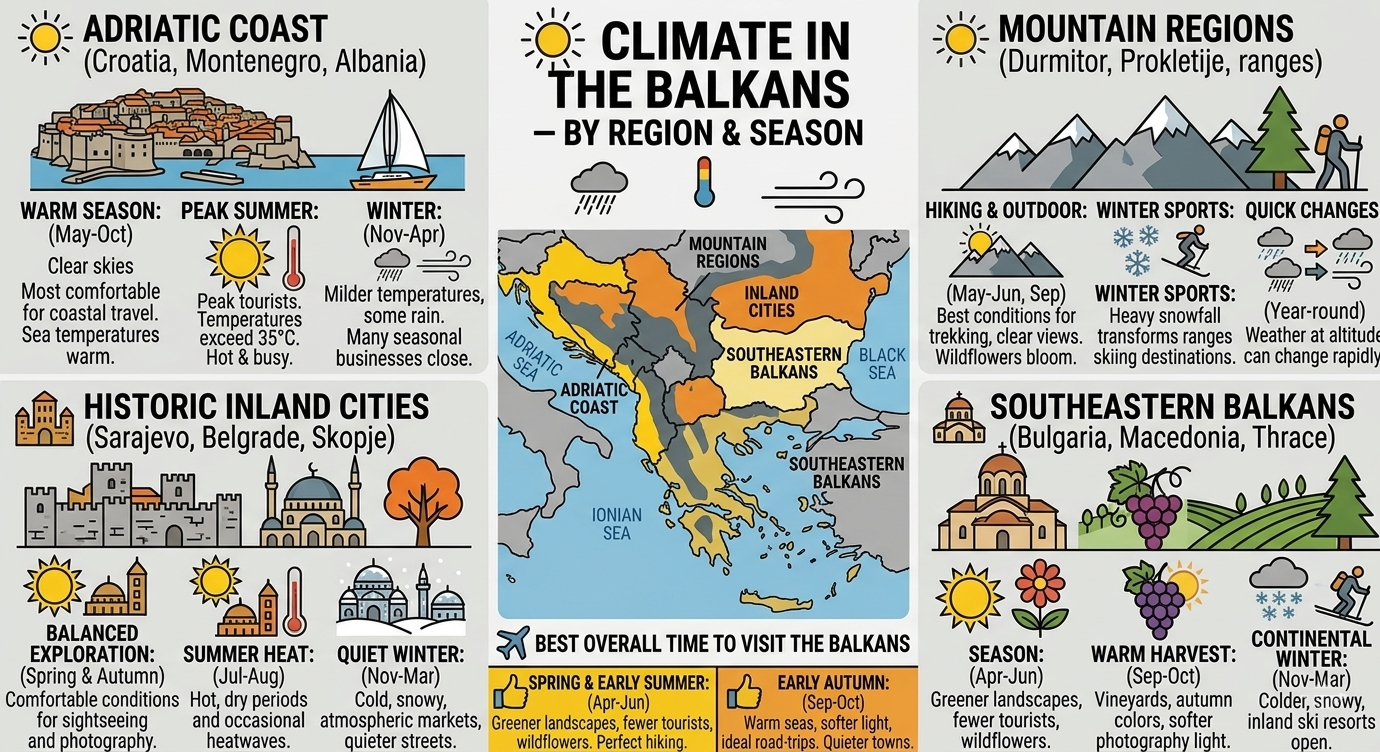
The Balkans have a remarkably varied climate for such a compact region, shaped by the Adriatic coastline, high mountain ranges, inland plains, and Mediterranean influences. Summers can be intensely hot along the coast, while mountain regions remain cool and green even in mid-summer. Winters vary from mild on the Adriatic to snowy and continental inland. Because the region stretches across several countries and landscapes, the Balkans can be visited year-round depending on the style of trip you are planning.
Best Overall Time to Visit
These months offer the most balanced travel conditions across the Balkans, with pleasant temperatures, greener landscapes, and fewer tourists before the peak summer crowds arrive.
Wildflowers bloom across mountain regions during late spring, particularly in Montenegro, Bosnia & Herzegovina, and northern Albania.
Hot Coastlines & Festival Season
Summer brings long sunny days and very warm temperatures, especially along the Adriatic coast where tourism peaks dramatically.
Temperatures along the coast often exceed 35°C, particularly in Croatia, Montenegro, and parts of Albania. Inland cities can also become very hot.
Warm Seas & Softer Light
Early autumn is one of the best periods for travelling in the Balkans. Sea temperatures remain warm after summer, while tourist crowds decrease significantly.
September is often considered the perfect balance between weather and crowd levels.
Snowy Mountains & Quiet Cities
Winter conditions vary greatly across the region.
Some mountain roads and remote villages can become difficult to access during heavy snow periods.
A guided kayaking tour of Kotor Bay and a night walk through Dubrovnik's old city walls are the two things I'd book in advance — both fill up fast and the difference between a good and great guide here is significant.
The Balkans reward a multi-country route — flying into Dubrovnik and out of Tirana (or Podgorica) makes for a far more logical trip than backtracking. Kiwi.com's multi-city search handles these open-jaw combinations better than most search engines.
Stock Photography
Browse and license the full Asia photography collection — available for commercial and editorial use on Shutterstock.
View on Shutterstock →
Stock Photography
Browse and license the full Arabic Style photography collection — available for commercial and editorial use on Shutterstock.
View on Shutterstock →